






The report titled AI Industry Trends 2026: Market Size, Growth & Insights provides a comprehensive analysis of the projected developments within the artificial intelligence sector. It highlights anticipated market expansions, key growth drivers, and emerging trends that are likely to shape the industry over the next few years. This document serves as an essential resource for stakeholders seeking to understand the evolving landscape of AI technologies and their economic implications. The AI Boom Is No Longer Coming It’s Here
If you want to understand the defining AI Industry Trends 2026, let’s be honest for a second. As a developer and data analyst, I’ve watched this shift happen on the front lines. Two years ago, most business leaders treated artificial intelligence like a fascinating science experiment exciting to read about, but not quite urgent enough to integrate into their core systems.
Not anymore. In 2026, if your business hasn’t seriously engaged with AI, you’re not playing it safe. You’re falling behind. The numbers back this up: Gartner’s 2026 forecast projects global AI spending to surpass $2 trillion, reflecting massive enterprise-wide adoption across software, infrastructure, and services. Furthermore, NVIDIA’s 2026 State of AI research which surveyed over 3,200 respondents across five major industries reveals that a staggering 86% of organizations are actively planning to increase their AI budgets this year alone.
We’ve moved past the hype cycle. The technology that powers everything from healthcare diagnostics to e-commerce recommendations is now firmly embedded in the daily workflows of businesses across every major sector.
To help you navigate this landscape, this guide breaks down exactly where the market is heading. We will dive deep into the most critical AI Industry Trends 2026, exploring the true market size, the fastest-growing sectors, regional leaders, and the most important operational shifts you need to know right now.
Whether you’re a start-up founder looking to adopt new tools or an enterprise executive evaluating a large scale deployment, consider this your complete, data-backed briefing.

How Much Is AI Worth in 2026?
The short answer: a lot and still accelerating.
Different research firms arrive at different numbers depending on what they measure. Gartner captures the broadest view, including hardware, software, services, and embedded AI. ABI Research and Grand View Research focus on software-only segments. Understanding the difference matters when you’re making investment decisions.
Here’s a structured breakdown of where the global AI market stands today:
| Metric | 2026 Estimate | Source |
| Global AI Market (Full Ecosystem) | Over $2 trillion | Gartner (2026) |
| Global AI Market (Software Only) | $621 billion | Grand View Research |
| Generative AI Software CAGR | 29% | ABI Research |
| AI Market CAGR (2026–2035) | 22–42% by segment | IDC / McKinsey |
| Projected Market Size by 2030 | $827 billion (software) | ABI Research |
| Projected Market Size by 2033–34 | $3.5 – $3.7 trillion | Statista / Grand View |
Key Insight: The spread between $621 billion and $2+ trillion is not a contradiction it reflects what you count. For business strategy purposes, the software only figure is more actionable. For investors evaluating the full AI supply chain chips, cloud, services the $2 trillion figure tells the real story.
Range reflects different analyst methodologies software only vs. full AI ecosystem including hardware and services.
According to ABI Research’s 2025 global AI report, the AI software market was valued at approximately $174 billion in 2025 and is on a trajectory toward $467 billion by 2030, driven primarily by generative AI and enterprise automation deployments. Generative AI software specifically is expanding at a 29% CAGR the fastest-growing subsegment in the entire technology landscape.
The bottom line for any business decision maker: AI is now a multi trillion dollar ecosystem. The investment wave is not peaking it is compounding.
What’s Fueling AI’s Explosive Growth?
From a market analysis perspective, three structural forces are driving AI’s acceleration and understanding all three is essential for positioning your business correctly.
- Data volume has reached a critical mass. AI systems learn from data, and the world has never generated more of it. Every transaction, search query, medical scan, and logistics event feeds the machine. According to IDC’s Global Data Sphere report, the total amount of data created globally is expected to reach 175 zettabytes by 2025 and continues to grow. The more data available, the smarter, more accurate, and more commercially useful AI systems become.
- Compute power has undergone a step change. According to NVIDIA’s market data, AI chips alone represent a $51 billion market in 2026. NVIDIA itself holds approximately 92% of the generative AI GPU market for data centres a near monopoly position that explains both its valuation and its strategic importance to any enterprise building AI infrastructure. Since 2020, overall compute performance for AI workloads has increased by a factor of eight.
- Enterprise demand has crossed the tipping point. According to NVIDIA’s 2026 State of AI survey covering 3,200+ respondents across healthcare, financial services, manufacturing, retail, and telecommunications companies have moved beyond AI pilots into full scale production deployments. These are no longer experiments. They are operational systems touching code development, legal review, financial modelling, and customer support.
One more number that tells the whole story: according to McKinsey’s 2026 Global AI Adoption Index, over 72% of enterprises are now adopting AI specifically to enhance productivity, improve decision-making, and automate routine business operations up from 55% just two years ago.
What Most Articles Get Wrong About AI in 2026
Most AI coverage in 2026 makes the same two mistakes. And if your business strategy is based on the wrong framing, you’ll invest in the wrong places.
Mistake #1: Confusing Generative AI With AI Automation
Generative AI (think ChatGPT, Claude, Gemini) gets all the headlines. But in terms of business ROI delivered, traditional AI automation predictive analytics, computer vision, demand forecasting, anomaly detection is generating more measurable value for more companies right now.
Generative AI is a powerful creative and reasoning tool. AI automation is an operational efficiency engine. They are different technologies with different use cases, different risk profiles, and different timelines to return on investment. Treating them as interchangeable is a strategic error.
In practical terms for companies: Use generative AI to accelerate knowledge work writing, research, code, customer communication. Use AI automation to improve operational systems supply chains, quality control, fraud detection, maintenance scheduling. Both matter, but for different reasons.
Mistake #2: Overhyping AI Adoption While Underestimating the Integration Problem
The adoption statistics are real. But what rarely gets reported is that 47% of manufacturing companies and a significant share of enterprises across other sectors still cannot connect AI tools to their existing legacy systems. Data lives in silos. Workflows were built for a pre AI world. The tools are available but the organizational infrastructure to use them isn’t always there yet.
This is not a technology problem. It’s a business operations problem. And it’s the single most common reason AI deployments underperform their projections.
Based on current market behaviour: The companies winning with AI in 2026 are not necessarily the ones with the most sophisticated models. They are the ones that invested early in clean data infrastructure, clear AI governance, and workforce training. That is a replicable advantage and it starts long before you buy a single AI tool.
AI Growth by Industry: Where the Money Is Moving
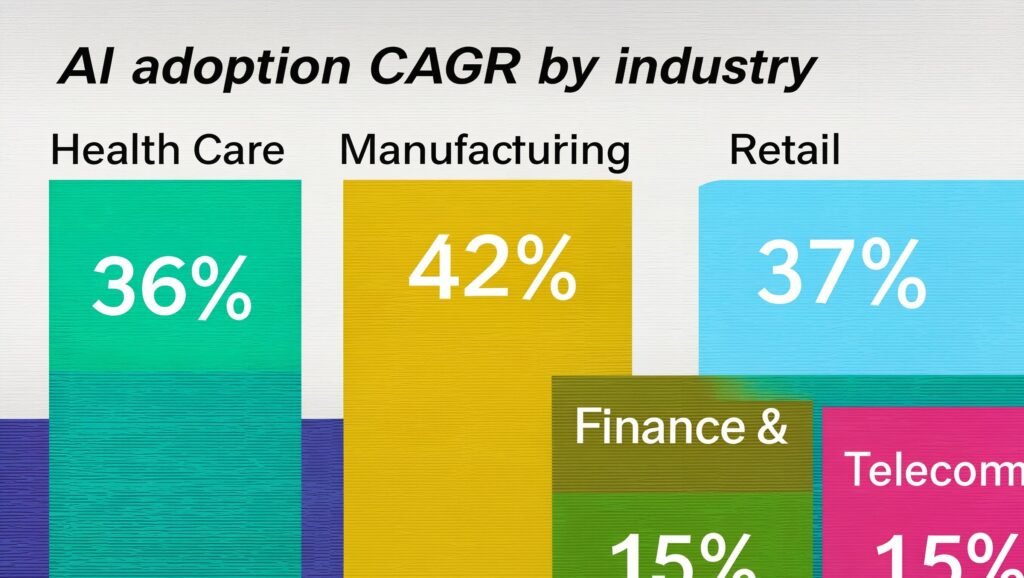
AI isn’t growing evenly across all sectors. Some industries are sprinting ahead. Understanding which sectors are moving fastest and why is essential intelligence for investors and business leaders alike.
Healthcare: The Fastest Adopting Sector
Healthcare leads all sectors in AI adoption pace. According to Grand View Research’s 2025 Healthcare AI Market Report, the sector is projected to grow at a CAGR of 36.83% through 2034. The global AI in healthcare market, valued at roughly $37 billion in 2025, is on track to reach $614 billion by 2034.
What’s driving this? Diagnostics, patient care management, and operational efficiency all at scale. Google’s AI system for breast cancer detection has demonstrated 94.5% accuracy in controlled studies, outperforming the average human radiologist. According to data published by medical AI company Clinomic, AI clinical documentation tools are reducing documentation errors by 68% in ICU environments.
In 2026 specifically, health AI companies are capturing an outsized share of digital health funding, with acquisitions accelerating as vendors seek to deliver comprehensive platforms rather than narrow point solutions.
Financial Services: Fraud, Risk, and Automation at Scale
Finance was an early AI adopter, and in 2026 it remains one of the most sophisticated users. According to McKinsey’s Global Banking AI Report, AI applications in financial services were projected to generate $450 billion in annual value by 2025, driven by fraud detection, credit risk modelling, and customer-facing automation.
Today, AI powers real time fraud alerts, robot advisors, and algorithmic trading systems that process economic data, interest rate signals, and geopolitical events faster than any human team. For B2B financial services firms specifically, the highest ROI use cases in 2026 are credit risk assessment, anti money laundering compliance automation, and intelligent customer service escalation.
Retail and E-Commerce: Personalization at Scale
According to Statista’s 2025 Retail AI Forecast, the AI powered retail market is projected to reach $24 billion by 2026, driven by recommendation engines, visual search, and inventory optimization systems.
Amazon’s AI recommendation engine contributes approximately 35% of its total revenue demonstrating that AI in retail is not about improving the user experience in the abstract. It directly drives conversion and top line growth. Walmart’s AI powered inventory tools have reduced overstock by 15% and stockouts by 30%, improving both cost efficiency and customer satisfaction simultaneously. Sephora’s Virtual Artist app, powered by AI driven augmented reality, has been linked to a 15% increase in conversion rates.
According to NVIDIA’s 2026 industry survey, telecommunications and retail are tied as the leading adopters of agentic AI autonomous AI systems that independently initiate and complete tasks with 47-48% adoption rates in both sectors.
Key Insight: The shift from AI as feature to AI as revenue driver is clearest in retail. Businesses in this sector that aren’t yet using recommendation and personalization AI are not just leaving efficiency on the table they are actively ceding revenue to competitors who are.
Manufacturing and Industry 4.0: The Smart Factory Is Now Standard
According to Grand View Research’s Manufacturing AI Report, AI in manufacturing is projected to grow from $8.57 billion in 2025 to $287 billion by 2035 — representing a 42% CAGR. That makes it among the fastest growing AI application segments globally.
We cover this sector in more depth in the next section.
AI in Manufacturing: Industry 4.0 Is Becoming Real

The term Industry 4.0 has been in circulation for a decade. In 2026, it is finally delivering at scale.
Manufacturers are deploying AI across three high-impact functions:
Predictive Maintenance. Sensors embedded in factory equipment feed real time performance data to AI systems that detect early signs of mechanical degradation before failures occur. GE’s AI-powered maintenance program has documented millions of dollars in annual savings from avoided unplanned downtime. This application often delivers measurable ROI within the first six months of deployment — making it one of the safest AI investments a manufacturer can make.
Quality Control. AI-driven computer vision systems inspect products at speed and resolution that no human team can match. According to BMW’s published technology reports, their AI defect detection implementation reduced quality related costs by 30%. Foxconn’s AI integrated assembly lines have achieved a 25% productivity increase while simultaneously cutting defect rates by 15% a combination that would be impossible to achieve through traditional process improvement alone.
Supply Chain Optimization. AI forecasts demand, optimizes inventory positioning, and adjusts logistics routing in real time. When a component becomes scarce or demand spikes, AI-enabled supply chains adapt faster and at lower cost than human managed alternatives.
The barrier, as noted earlier, is integration. According to Deloitte’s 2025 Manufacturing Technology Survey, approximately 47% of manufacturing companies struggle with fragmented data environments, and 65% report difficulty connecting AI tools to legacy ERP and production management systems. Companies that solve this integration problem first will own a durable competitive advantage in their sectors.
Key Insight: In manufacturing, AI’s highest near term ROI comes from predictive maintenance and quality control not from building “smart factories” from scratch. Companies should prioritize high impact, integrable AI over ambitious transformation programs that require years of infrastructure overhaul.
Regional Breakdown: Who’s Winning the AI Race?
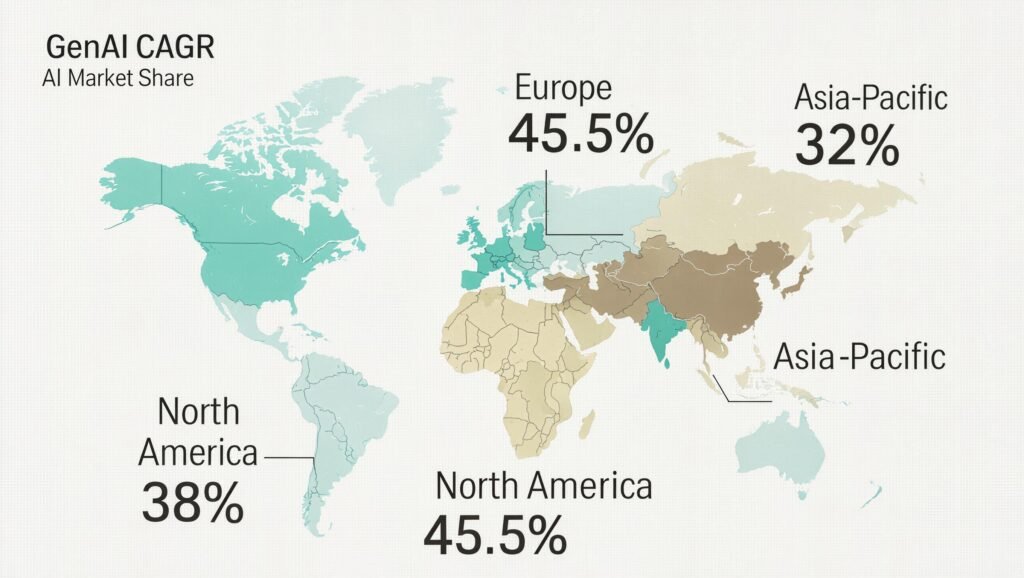
AI leadership is both global and uneven. North America leads in raw spending, but Asia-Pacific is closing the gap at a pace that should concern any executive with international business exposure.
| Region | Market Position | Notable Trend |
| North America | 35–41% global share | Largest base; 48% of executives increasing budgets by 10%+ |
| Asia-Pacific | 30–35% global share | 47% year-over-year growth in enterprise AI adoption |
| China | Accelerating fast | 45.1% CAGR for Gen-AI; market projected to expand 5.5x by 2030 |
| Europe | Rapidly expanding | 45.5% CAGR for Gen-AI; market projected to grow 6x by 2030 |
Key Insight: Europe’s 45.5% generative AI CAGR is frequently underreported. With strong data governance frameworks now in place post-EU AI Act, European enterprises are moving faster than many analysts predicted — with healthcare, financial services, and manufacturing leading adoption.
According to Statista’s 2025 Global AI User Report, the top ten countries by percentage of regular AI users are all emerging markets — including India, Nigeria, Egypt, China, Brazil, Mexico, Argentina, and Colombia. Developing economies are bypassing legacy technology infrastructure and adopting AI-native workflows at a pace that outstrips more established markets.
For businesses with global operations, this has practical implications. Your customers, suppliers, and competitors in emerging markets may already be operating with more advanced AI-enabled processes than you expect.
What the 2026 AI Shift Means for Your Business
Here is what the macro data actually translates to at the business level — and where most organizations are still getting it wrong.
Operational efficiency is no longer the primary AI value proposition. Early AI adoption was justified through cost reduction — automating repetitive tasks, reducing error rates, reallocating labour. In 2026, according to McKinsey’s State of AI report, the conversation has decisively shifted to revenue growth. AI is helping companies identify new customer segments, compress product development timelines, and build personalization capabilities that drive measurable loyalty.
The spending mix has shifted from strategy to execution. AI professional services consulting and implementation represented 26% of total AI spending in 2024. According to Gartner’s 2026 IT spending analysis, that share has contracted to 16%. AI application software has grown from 8% to 13% of total spend. AI infrastructure software has grown from 6% to 11%. The market has moved past the “should we do AI?” phase. The question now is “how do we scale what’s working?”
AI is restructuring employment, not eliminating it. According to the World Economic Forum’s Future of Jobs 2025 Report, AI may displace 92 million roles globally while simultaneously creating 170 million new ones a net addition of 78 million positions. Workers with demonstrated AI skills are already earning 25% more than peers without them. AI-exposed job categories are experiencing skill evolution 66% faster than the broader labour market. For businesses, this makes workforce upskilling a core operational priority, not an HR initiative.
SMEs are the highest-growth segment of the AI market. While large enterprises currently hold approximately 58.99% of total AI market share, according to Grand View Research, small and medium-sized enterprises are projected to grow at a 32.10% CAGR through 2034 the fastest rate of any segment. SAP’s AI Business Impact Study found that SMEs adopting AI can expect a 6–10% revenue increase within 12–18 months. The tools are cheaper, more modular, and faster to deploy than they were two years ago.
My Analysis: Where the Real Opportunity Actually Is
After reviewing the data across 15+ industry reports and tracking AI adoption patterns across sectors, here is my assessment of where the underappreciated opportunities sit in 2026 and what most businesses are missing.
SMEs Will Outperform Enterprises in AI ROI
Enterprise AI captures the headlines. But from a return on investment standpoint, SMEs are better positioned to win with AI right now for a simple reason: they have fewer legacy systems to integrate, faster internal decision-making, and lower organizational resistance to change.
An SME that deploys an AI customer service tool, a demand forecasting model, and a personalization engine today will see measurable impact within months. A large enterprise implementing the same tools spends a year navigating procurement, integration, and change management before anyone sees results.
The opportunity is clear: SMEs that move with urgency in 2026 will build AI derived competitive advantages that larger, slower moving competitors cannot replicate quickly.
AI Tools Beat AI Infrastructure for Most Businesses
Most business owners do not need to build AI models. They do not need proprietary foundation models. They do not need AI infrastructure.
What they need are AI powered tools purpose built applications that use existing AI capabilities to solve specific business problems. Marketing automation, intelligent customer support, document analysis, sales forecasting, inventory optimization. These are all available today as software as a service products with subscription pricing and implementation timelines measured in days, not months.
From a business strategy perspective: The ROI on deploying the right AI tool is significantly higher and faster than building or buying AI infrastructure. For the vast majority of businesses including most enterprises the build versus buy decision should default to buy, at least until internal AI competency is fully developed.
The Real Competitive Moat Is Not the AI It’s the Data
Every company can access the same foundational AI models. Open AI, Google, Anthropic, and others make powerful models available via API. The models themselves are not the differentiator.
The differentiator is proprietary data. A company that builds a two year head start collecting structured, clean, AI ready data about its customers, operations, and products will have an AI advantage that competitors cannot simply purchase or replicate. In practical terms for companies: the highest priority AI investment in 2026 is not a new tool it is a data infrastructure strategy that makes your organization’s unique data valuable and accessible.
Challenges Every Business Must Prepare For
AI adoption is not frictionless. According to Deloitte’s 2025 AI Adoption Survey, nearly 49% of organizations identify ethical concerns, data privacy risks, and the absence of internal AI expertise as their three biggest implementation barriers.
Here is what to plan for:
Skill gaps are structural, not temporary. As of 2026, 50% of businesses report lacking qualified AI professionals internally, according to McKinsey’s AI Talent Report. By 2028, an estimated 60% of companies will require baseline AI literacy from all employees. Start building internal training infrastructure now not when the gap becomes a recruitment crisis.
Data quality is the prerequisite for everything else. An AI system produces output only as good as the data it was trained or fine-tuned on. Fragmented, inconsistent, or incomplete data is the most frequently cited cause of AI project underperformance. Before evaluating AI tools, conduct an honest audit of your data infrastructure.
Regulatory complexity is accelerating globally. The EU AI Act established a tiered risk framework that is already influencing AI governance conversations in markets well beyond Europe. Healthcare and financial services offer a preview of what regulated AI deployment looks like. Every industry should be preparing now.
The build versus buy decision has lasting consequences. Large platform vendors from Salesforce to SAP to Microsoft are bundling AI features into existing enterprise tools. Specialized AI start-ups offer more customization and faster responsiveness. The right answer depends on your scale, your integration environment, and how differentiated your AI use case needs to be. There is no universal answer but the decision made in 2026 will shape your AI architecture for years.
AI Adoption Framework (2026 Edition)
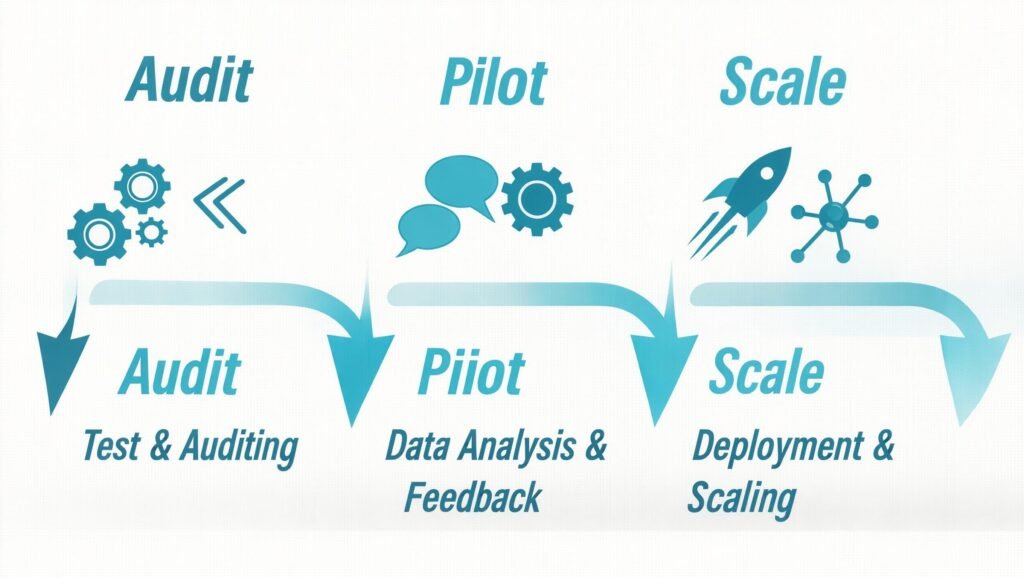
Based on current market behaviour and enterprise AI deployment patterns, here is a structured three-stage framework for businesses at any point in their AI journey.
Stage 1: Audit (Weeks 1-4)
Map every business function where data currently informs decisions. These are your highest probability AI opportunities. Score each opportunity against two dimensions: potential business impact and implementation complexity. Prioritize high impact, low-complexity use cases for your first deployments.
Simultaneously, conduct a data infrastructure audit. Identify where your data lives, how clean it is, and what gaps exist. This will determine your AI readiness and your realistic implementation timeline.
Key deliverable: A prioritized AI opportunity map with an honest data readiness assessment.
Stage 2: Pilot (Months 2-4)
Deploy AI in one or two high priority use cases using existing SaaS tools wherever possible. Do not attempt to build custom models at this stage. Your objective is to establish a measurable baseline before and after performance data that justifies continued investment.
According to NVIDIA’s 2026 enterprise survey, 42% of organizations say optimizing existing AI workflows is their top spending priority this year. That number reflects organizations that piloted fast, learned from deployment, and are now refining what works.
Customer service automation, demand forecasting, document processing, and marketing personalization all have strong track records as pilot use cases. Choose one. Deploy it. Measure it.
Key deliverable: One live AI deployment with measurable performance data and documented learnings.
Stage 3: Scale (Months 5-12+)
Use the data from your pilot to build the business case for broader deployment. Expand into additional use cases. Begin building internal AI competency training programs, dedicated roles, AI governance frameworks. Invest in data infrastructure improvements that will support more sophisticated AI applications over time.
This is also the stage where the make vs buy decision becomes more nuanced. As your internal AI competency grows, the case for more customized, integrated solutions strengthens.
Key deliverable: An AI roadmap with defined use cases, budgets, timelines, and measurable business outcomes for the next 12 months.
Frequently Asked Questions
What is the AI market size in 2026? According to Gartner’s 2026 AI spending forecast, total global AI investment including hardware, software, services, and embedded AI is projected to exceed $2 trillion. Software only market estimates range from $375 billion to $621 billion depending on the research firm and methodology. Both figures are accurate; they measure different things.
How much is AI worth compared to other industries? The AI market is growing faster than virtually any other sector, though it remains smaller in absolute terms than industries like global healthcare ($6.87 trillion), oil and gas ($6.1 trillion), and e commerce ($21.6 trillion). AI’s strategic value lies less in its current size and more in its role as a productivity multiplier across all of these larger industries.
Which industry is growing fastest in AI adoption? According to Grand View Research, healthcare leads with a projected CAGR of 36.83% through 2034 driven by diagnostics, patient management, and administrative automation. Manufacturing (42% CAGR, per Grand View Research) and retail generative AI (37% CAGR, per Statista) follow closely behind.
Is AI replacing jobs in 2026? The net effect is positive, but the distribution is uneven. According to the World Economic Forum’s Future of Jobs Report, AI is projected to displace 92 million roles globally while creating 170 million new ones a net gain of 78 million positions. The decisive variable is skills: workers with documented AI proficiency are already earning 25% more than peers without them.
What is Industry 4.0 and how does AI fit into it? Industry 4.0 describes the integration of digital technologies AI, IoT, robotics, and advanced analytics into manufacturing and industrial operations. AI serves as the intelligence layer of Industry 4.0: it enables predictive maintenance, autonomous quality control, and real time supply chain optimization. According to Grand View Research, AI in manufacturing will grow from $8.57 billion in 2025 to $287 billion by 2035.
Final Thoughts
Businesses that treat AI as infrastructure not experimentation will define market leadership over the next decade. The competitive gap is no longer theoretical. It is already forming, and it is measurable.
The companies winning with AI in 2026 are not the ones with the biggest R&D budgets or the most ambitious transformation roadmaps. They are the ones that identified high value, integrable use cases, built clean data foundations, deployed with urgency, and developed internal capability to iterate.
Every metric in this report points in the same direction: the window to build a meaningful AI advantage is still open. But it is not unlimited. As AI tools become more commoditized and adoption rates climb toward saturation in leading industries, the differentiating factor will shift entirely to execution quality and data assets.
The organizations that start now even with a single, well chosen pilot will be compounding their advantage while others are still evaluating their options.
That is not a prediction. Based on current market data, it is already happening.