
AWS Gives You $200 in Free Credits Here’s How to Run Claude on It for Free
Table Of Contents
show
Quick Answer
 Sign up for an AWS account and choose the Free Plan to get $100 in credits instantly. Complete the five onboarding activities in the “Explore AWS” widget one of which is invoking a model in Amazon Bedrock to unlock the second $100, for $200 total. Enable Claude model access in the Bedrock console under Model Access, then call it through the Bedrock console playground, the SDK, or Claude Code configured to use Bedrock as its backend. The credits are usable for six months or until they run out, whichever comes first, and they apply to Bedrock inference the same way they apply to EC2 or S3.
1. New AWS accounts (post July 2025) get $100 automatically, up to $200 total after five onboarding tasks
2. Amazon Bedrock is one of the five qualifying tasks, so claiming the credits and testing Claude naturally overlap
3. Claude access in Bedrock isn’t automatic you request it separately in the Model Access panel, and some models also need an AWS Marketplace subscription step
4. Bedrock itself has no dedicated free tier; it draws down the same $200 pool as every other AWS service
5. Set a AWS Budget alert immediately, since $200 disappears fast at Claude’s per token rates if you leave a script running unattended
Sign up for an AWS account and choose the Free Plan to get $100 in credits instantly. Complete the five onboarding activities in the “Explore AWS” widget one of which is invoking a model in Amazon Bedrock to unlock the second $100, for $200 total. Enable Claude model access in the Bedrock console under Model Access, then call it through the Bedrock console playground, the SDK, or Claude Code configured to use Bedrock as its backend. The credits are usable for six months or until they run out, whichever comes first, and they apply to Bedrock inference the same way they apply to EC2 or S3.
1. New AWS accounts (post July 2025) get $100 automatically, up to $200 total after five onboarding tasks
2. Amazon Bedrock is one of the five qualifying tasks, so claiming the credits and testing Claude naturally overlap
3. Claude access in Bedrock isn’t automatic you request it separately in the Model Access panel, and some models also need an AWS Marketplace subscription step
4. Bedrock itself has no dedicated free tier; it draws down the same $200 pool as every other AWS service
5. Set a AWS Budget alert immediately, since $200 disappears fast at Claude’s per token rates if you leave a script running unattended
Key Takeaways
1. The $200 figure is a maximum, not a guarantee the first $100 is automatic, the second $100 requires action 2. Claude in Bedrock is billed per token like the direct Anthropic API, so credits get consumed by usage, not by a flat monthly allotment 3. AWS Activate is a separate, much larger credit program aimed at startups and is not what most individual developers will qualify for 4. Model access approval in Bedrock is typically near-instant, but a Marketplace subscription requirement can trip up an otherwise correct setupEntity Definitions
AWS Free Tier: AWS’s onboarding credit program for new accounts, restructured in July 2025 from a 12 month always free model into a $200 credit balance redeemable across 200+ services. Amazon Bedrock: A fully managed AWS service that provides API access to foundation models from multiple providers including Anthropic, Meta, Mistral, and Amazon’s own Nova family without requiring you to host any infrastructure. AWS Activate: AWS’s startup credit program, separate from the Free Tier, offering anywhere from $1,000 to roughly $100,000-$300,000 depending on the tier and VC or accelerator affiliation. Claude Code: Anthropic’s terminal-based coding agent, which can be configured to route its model calls through Amazon Bedrock instead of the direct Anthropic API.Feature/Topic Breakdown

How the $200 credit actually works
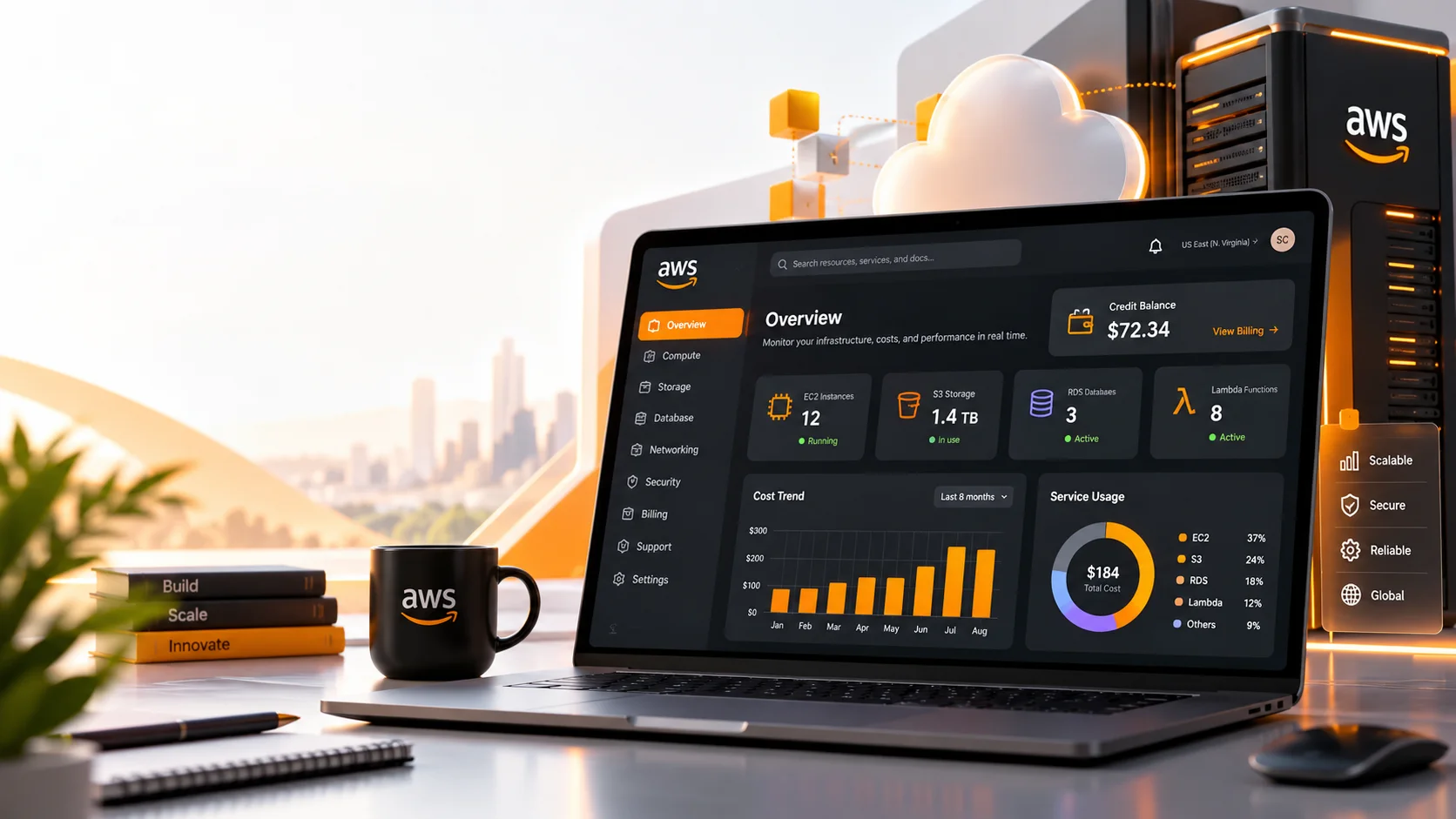
AWS overhauled its new account offer on July 15, 2025. The old system 12 months of always free usage tiers on services like EC2 and S3 no longer applies to accounts created after that date. In its place, every new signer chooses between a Free Plan and a Paid Plan. Both start with the same $100 credit; the difference is that the Free Plan restricts you to a subset of services and auto closes the account when credits run out or six months pass, while the Paid Plan gives full service access and switches you to standard billing once credits are exhausted. The second $100 isn’t automatic. AWS grants it as you complete five short onboarding activities surfaced in the “Explore AWS” widget on your account dashboard trying EC2, RDS, Lambda, Bedrock, and setting up AWS Budgets, at roughly $20 of credit per activity. This is the detail that makes this guide relevant rather than redundant with a generic “free AWS credits” roundup: the Bedrock activity and the free credits themselves are the same task. You don’t need to separately look for a “free Claude credits” program invoking a model in Bedrock during onboarding both unlocks part of your $200 and gets Claude running. Credits apply across more than 200 AWS services and expire 12 months after account creation, though the Free Plan itself is capped at six months or full credit depletion. The offer isn’t available in AWS GovCloud (US) or the AWS China regions.Enabling Claude in Bedrock’s model catalog
Being listed in Bedrock’s model catalog and being able to actually call a model are two different things. Even after your account exists, Claude models sit behind an access request: 1. Open the Amazon Bedrock console and go to Model access in the left navigation. 2 Choose Modify model access (sometimes shown as Manage model access). 3. Find the Anthropic section and select the Claude models you want for most people starting out, that means the current Sonnet and Haiku tiers. 4. Submit the use-case form AWS requires for Anthropic models specifically. This is separate from general Bedrock account setup and only needs to be done once per account. 5. Wait for the access status to flip to Access granted this is usually near-instant, though AWS doesn’t guarantee a specific turnaround time. One setup detail that trips up a fair number of people, based on developer discussion threads and AWS’s own support documentation: some Claude models additionally require an AWS Marketplace subscription behind the scenes, separate from the Model Access approval. If you get a “model is not available for this account” error despite seeing the model listed via the API, that Marketplace subscription step is the first thing to check the IAM permissionsaws-marketplace:Subscribe and aws-marketplace:ViewSubscriptions are what let this happen automatically on first invocation.
Connecting Claude in Bedrock to your workflow
 Once access is granted, you have a few ways to actually use it:
1. Console playground: Bedrock’s Text or Chat playground lets you test a model directly in the browser the fastest way to confirm access is working before writing any code.
2. AWS SDK (Boto3, etc.): Standard
Once access is granted, you have a few ways to actually use it:
1. Console playground: Bedrock’s Text or Chat playground lets you test a model directly in the browser the fastest way to confirm access is working before writing any code.
2. AWS SDK (Boto3, etc.): Standard bedrock runtime API calls using Invokemodel or the Converse API, authenticated with your normal AWS credentials.
3. Claude Code: Anthropic’s coding agent can use Bedrock as its backend instead of the direct Anthropic API. The built-in setup wizard (/setup-bedrock inside Claude Code, or the login prompt’s “3rd-party platform” option) detects your AWS credentials, verifies which Claude models your account can actually invoke, and lets you pin specific versions useful since Bedrock model IDs are versioned and can otherwise shift under you.
For manual configuration outside the wizard, the relevant environment variables are CLAUDE_CODE_USE_BEDROCK=1 and AWS_REGION set to a region where your chosen Claude model is available Anthropic model availability varies by AWS region, so it’s worth checking the current supported regions list before assuming a model works everywhere.
Making the $200 last
 Bedrock has no free-tier allowance of its own it bills from the first token, drawing down the same shared credit balance as every other service on your account. A few practical guardrails:
1. Turn on Free Tier usage alerts under Billing Preferences, which by default email the account root user at 85% of free tier usage.
2. Separately, set up an AWS Budget with a low threshold (even $1-2) and alerts at 50/80/100%, since Free Tier alerts alone won’t catch Bedrock-specific overspend once you’re past the initial free-usage categories.
3. Prefer cheaper models for iteration a smaller Claude model for drafts and debugging, reserving a larger model for final output, since Bedrock’s per-token pricing scales significantly between tiers.
4. Turn on model invocation logging if you want to reconcile per-call token counts against your bill; it’s off by default.
5. Remember that AWS Budgets alerts update roughly once a day, not in real time they’re a monitoring layer, not a hard spending cap, so a runaway script could still burn credit between check-ins.
Bedrock has no free-tier allowance of its own it bills from the first token, drawing down the same shared credit balance as every other service on your account. A few practical guardrails:
1. Turn on Free Tier usage alerts under Billing Preferences, which by default email the account root user at 85% of free tier usage.
2. Separately, set up an AWS Budget with a low threshold (even $1-2) and alerts at 50/80/100%, since Free Tier alerts alone won’t catch Bedrock-specific overspend once you’re past the initial free-usage categories.
3. Prefer cheaper models for iteration a smaller Claude model for drafts and debugging, reserving a larger model for final output, since Bedrock’s per-token pricing scales significantly between tiers.
4. Turn on model invocation logging if you want to reconcile per-call token counts against your bill; it’s off by default.
5. Remember that AWS Budgets alerts update roughly once a day, not in real time they’re a monitoring layer, not a hard spending cap, so a runaway script could still burn credit between check-ins.
Real Use Cases
A solo developer prototyping an AI feature can use the free credits to run genuine Claude-powered testing in Bedrock before committing to a paid API relationship useful when a project is still being validated and every dollar of runway matters. A student or career changer building a portfolio project gets hands-on experience with both cloud infrastructure and a frontier LLM API using the same $200 pool, without juggling separate billing relationships. Teams evaluating whether to route production Claude usage through Bedrock (for reasons like existing AWS spend commitments or data residency) can use the free credits for that initial technical evaluation at effectively no cost.Pros
1. The credit and the “try Claude” activity are the same task, so there’s no separate signup or waitlist for Claude access specifically 2. Model access approval is typically near instant once you submit the use case form 3. Using Bedrock consolidates AI inference billing with the rest of your AWS spend, rather than managing a separate Anthropic invoice 4. Claude Code’s Bedrock setup wizard handles credential detection and model version pinning automaticallyCons
1. The full $200 isn’t automatic the second $100 requires completing all five onboarding activities 2. Bedrock has no dedicated free-usage allowance; every token drawn against Claude counts against the same shared credit pool as your EC2 or storage usage 3. The Free Plan account can auto close after six months regardless of remaining balance, which is a harder cut off than some people expect 4. The Marketplace subscription gotcha on top of Model Access approval isn’t obvious from the console UI alone and can cause confusing 403 errorsLimitations
This guide covers the standard $200 new account Free Tier credit, not AWS Activate, which is a separate and substantially larger program aimed at startups with VC, accelerator, or fintech partner affiliations (self serve tiers start around $1,000, with higher tiers reaching into the tens or low hundreds of thousands of dollars). The two programs aren’t mutually exclusive, but they have different eligibility rules and different application processes don’t expect Activate-level credit from the standard new-account signup. Bedrock model availability and pricing also change relatively often; verify current model names and per-token rates in the Bedrock console before budgeting a specific project, since Anthropic and AWS both update the catalogue periodically.Comparison Table

| AWS Free Tier (this guide) | AWS Activate | |
|---|---|---|
| Who it’s for | Any new AWS account | Startups with VC/accelerator/fintech affiliation, or self serve Founders tier |
| Typical credit | Up to $200 | $1,000 (self serve) up to roughly $100K-$300K (higher tiers) |
| Application required | No automatic at signup, plus onboarding tasks | Yes application and often a sponsoring partner |
| Covers Bedrock/Claude | Yes, as part of general service credit | Yes, redeemable against third party Bedrock models since April 2024 |
| Expiry | 6 months (Free Plan) or 12 months (credit expiry) | 12-24 months depending on tier |
Frequently Asked Questions
 Is Amazon Bedrock itself free? No. Bedrock has no permanent free tier and bills per token from the first call. What’s free is the shared $200 new-account credit, which can be spent on Bedrock the same way it can be spent on any other AWS service.
Do I need a credit card to get the $200? Yes AWS requires a valid payment method at signup regardless of which plan you choose, even though the Free Plan won’t charge it unless you explicitly upgrade or exceed the plan’s boundaries in ways that trigger closure rather than billing.
Can I use the credits for Claude Code specifically? Yes. Claude Code can be pointed at Amazon Bedrock as its backend instead of the direct Anthropic API, and Bedrock usage draws from the same account credit balance as any other Bedrock call.
What happens when the $200 runs out? On the Free Plan, the account closes rather than billing you further. On the Paid Plan, you move to standard pay as you go pricing for anything beyond the credit.
Is this the same as AWS Activate? No Activate is a separate, larger program for startups that requires an application and, for its higher tiers, an affiliated VC, accelerator, or partner organization.
Is Amazon Bedrock itself free? No. Bedrock has no permanent free tier and bills per token from the first call. What’s free is the shared $200 new-account credit, which can be spent on Bedrock the same way it can be spent on any other AWS service.
Do I need a credit card to get the $200? Yes AWS requires a valid payment method at signup regardless of which plan you choose, even though the Free Plan won’t charge it unless you explicitly upgrade or exceed the plan’s boundaries in ways that trigger closure rather than billing.
Can I use the credits for Claude Code specifically? Yes. Claude Code can be pointed at Amazon Bedrock as its backend instead of the direct Anthropic API, and Bedrock usage draws from the same account credit balance as any other Bedrock call.
What happens when the $200 runs out? On the Free Plan, the account closes rather than billing you further. On the Paid Plan, you move to standard pay as you go pricing for anything beyond the credit.
Is this the same as AWS Activate? No Activate is a separate, larger program for startups that requires an application and, for its higher tiers, an affiliated VC, accelerator, or partner organization.
Final Verdict
Who should use this: Individual developers, students, and early stage builders who want to experiment with Claude through a managed API without opening a direct Anthropic billing relationship, and who are comfortable working through AWS’s console for setup. Who should avoid this: Anyone expecting Bedrock to be free indefinitely, or teams with production-scale inference needs $200 of shared AWS credit disappears quickly once you’re running anything beyond light testing, and startups with real funding needs are better served applying to AWS Activate directly. Overall Score| Category | Weight | Score |
|---|---|---|
| Ease of Setup | 0.40 | 7.5/10 |
| Value / Credit Efficiency | 0.35 | 7.0/10 |
| Reliability & Longevity of Free Access | 0.25 | 6.0/10 |
| Overall | 7.0/10 |
Who Should Use It
Developers and students who want genuine Claude API access for a bounded project a portfolio piece, a hackathon, a short evaluation sprint and who don’t mind AWS’s console-driven setup in exchange for consolidated billing.Who Should Avoid It
Anyone planning sustained or production Claude usage should budget for real per token costs from day one rather than treating the $200 as anything beyond a trial runway; teams that already qualify for AWS Activate will get far more mileage applying there instead.Alternative Products
Developers who’d rather skip AWS entirely can access Claude directly through Anthropic’s own API and Claude Platform, which doesn’t require navigating Bedrock’s Model Access and Marketplace steps. Google Cloud and Microsoft Azure run comparable startup credit programs (Google Cloud for Startups, Microsoft for Startups Founders Hub) with their own foundation model access, for anyone comparing cloud ecosystems rather than committing to AWS specifically.Future Outlook
AWS has continued expanding Bedrock’s model catalogue and adjusting Claude pricing tiers through 2026, and the Free Tier credit structure itself was a mid 2025 overhaul meaning both the credit mechanics and the specific Claude models available are worth re checking against the current AWS console rather than assumed static, especially for anyone reading this more than a few months after publication.Sources
1. AWS “What’s New” announcement, AWS Free Tier $200 credit program (July 2025) 2. AWS Bedrock documentation Model access and Model catalogue 3. Anthropic Claude Platform documentation Claude in Amazon Bedrock 4. AWS Activate program pages and third party credit program comparisons 5. AWS Billing and Cost Management documentation Free Tier alerts and BudgetsYour $200 has a six-month clock it starts the moment your AWS account exists.
Every week you wait is runway you don’t get back. Sign up, choose the Free Plan, work through the five onboarding activities, and request Claude access in Bedrock’s Model Access panel. You can have Claude answering real prompts inside the hour.
→ Create your AWS account and start the Free Plan then head straight to Bedrock → Model Access and request Claude.
If your project touches images a portfolio site, a product demo, blog assets, app screenshots don’t let bloated file sizes slow down what you just built. Bloxstation free Image Compressor shrinks images without visibly hurting quality, right in your browser, no signup required.
Bestseller #1

- Discover The Power Of Ai And Robotics With Nvidia Jetson Nano 2Gb Developer Kit. It’S Small, Powerful, And Priced For Ev...
- Learning By Doing Is Key For Anyone New To Ai And Robotics, And The Jetson Nano 2Gb Developer Kit Is Ideal For Hands-On ...
- Thousands Of Jetson Nano Developers Actively Contribute Videos, How-Tos, And Open-Source Projects In Addition To The Fre...


One Response
Good post! We will be linking to this particularly great post on our site. Keep up the great writing